
🔦 Track 7: From CV to Career – Designing a Trusted AI Career Agent
🧩Current Situation (Alpha Stage)
reason.career is currently in its Alpha stage.
Today, the platform already enables:
- AI-supported CV creation
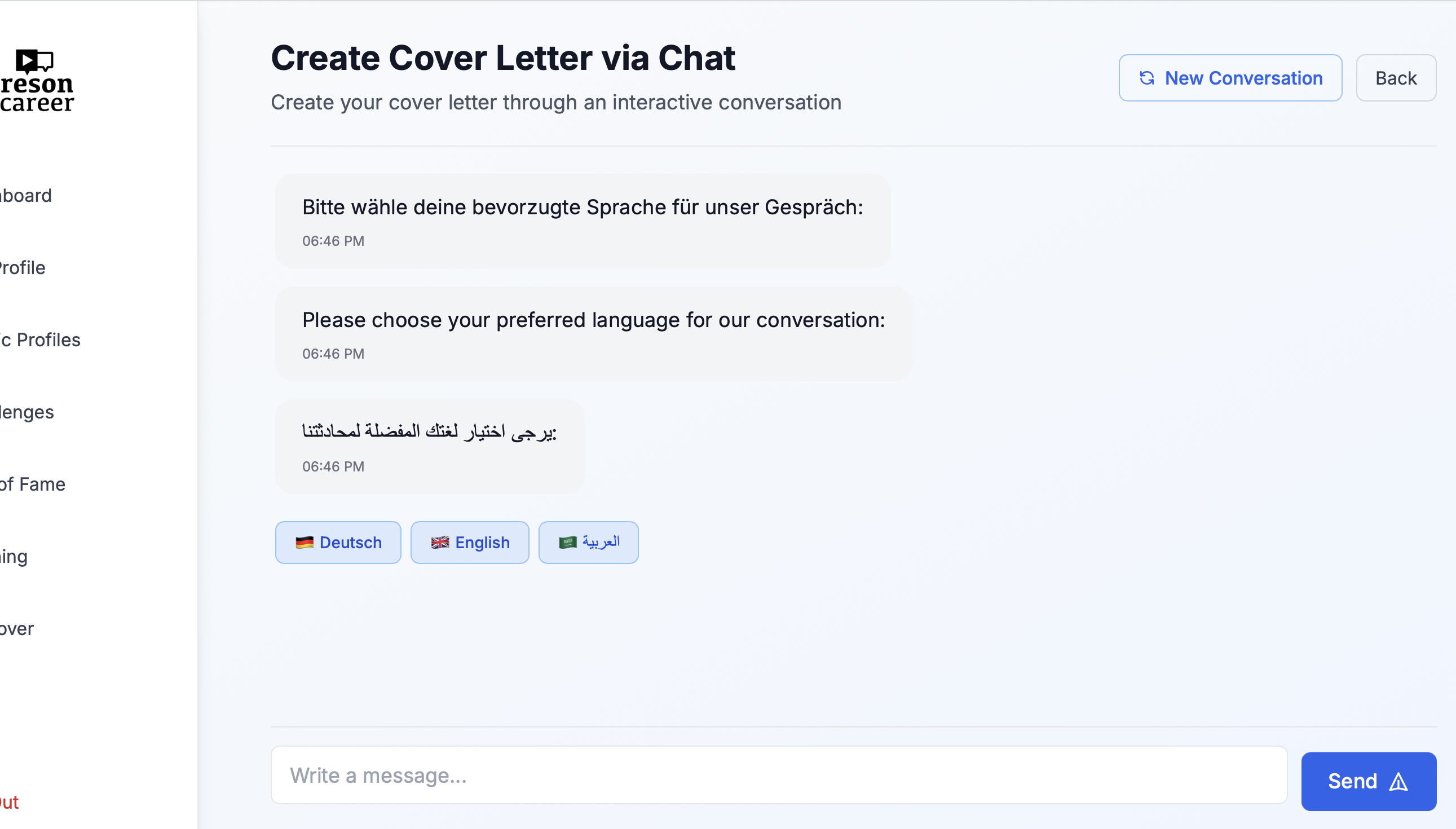
- AI-generated cover letters via chat
- A multilingual conversational interface
- A clear focus on students and early-career talents
The core mission of reason.carrere is to help young talents turn their education, skills, and projects into a professional CV — even when they have limited work experience.
Now, we want to evolve the platform further.
🎯 Challenge Goal
Your challenge is to help transform reason.career from a CV-building tool into a trusted AI-powered career companion.
This next generation of the platform should:
- Support talents beyond CV creation
- Help them navigate real career opportunities
- Treat personal and career data securely, responsibly, and transparently
🔐 Trust, Privacy & Data Responsibility (Core Principle)
Career data is highly sensitive.Therefore, trust and data protection are not optional — they are foundational to this challenge.
We explicitly encourage solutions that:
- Minimize the use of personal data
- Give users full control over when, how, and why their data is used
- Explore decentralized or privacy-preserving approaches for storing CV data
- Enable matching and recommendations without requiring direct access to personal identifiers
- Ensure that any AI Agent acts strictly in the interest of the talent
🧠 What You Are Asked to Build
🔍 1. Opportunity Discovery
Design a system that can find and structure real-world opportunities, including:
- Trainings & upskilling programs
- Certifications & bootcamps
- Hackathons & innovation challenges
- Accelerators & incubators
- Internships, trainee programs & entry-level jobs
Primary focus: KSA-based opportunities, with optional international programs.
🧩 2. Intelligent Career Matching
Match opportunities to a talent based on:
- Skills & experience from the CV
- Career goals & interests
- Time availability
- Budget constraints
The AI should clearly explain:
- Why a recommendation is relevant
- How it supports the talent’s career development
🤖 3. Trusted AI Agent (From Advice to Action)
Extend the system into a trusted AI Agent that can:
- Track deadlines and requirements
- Support or prepare applications and registrations
- Act on behalf of the user only with explicit consent
Key requirements:
- No hidden actions
- Full transparency
- Clear auditability of every step
Teams are encouraged to explore Fetch.ai to:
- Build autonomous yet controllable agents
- Separate personal data from decision logic
- Enable trustworthy agent-to-agent interactions
🧬 4. Optional: Decentralized CV & Career Data
Explore a future-oriented approach where:
- CV facts (skills, certificates, achievements) are stored independently of personal identifiers
- Personal data is not centrally exposed during matching
- Agents can search and validate qualifications without accessing names, emails, or contact details
Evaluate:
- Benefits and risks
- User trust implications
- Technical and regulatory feasibility
👥 Target Users
- Students creating their first CV
- Early-career professionals
- Talents exploring their next career steps
The solution should be simple for beginners and scalable for long-term use.
🌍 Why This Challenge Matters
This challenge is about building responsible AI.
Not just smarter recommendations —but trustworthy systems that empower talents, respect their data, and actively support their career growth.
🌐 What “Web3 CV” Means
In Web3, a decentralized CV isn’t a PDF — it’s a verifiable, wallet-linked identity of skills, achievements, and contributions stored on or anchored by decentralized protocols. Instead of relying on centralized resumes, Web3 CVs use cryptographic proofs and decentralized identifiers so skills can be independently verified and owned by the individual. (Mitosis University)
🧠 Core Standards & Technologies
📌 W3C Verifiable Credentials (VC)
A global standard for cryptographically verifiable credentials such as degrees, certificates, and attestations. They can be selectively shared and independently verified without a central authority. (Wikipedia)🔗 https://en.wikipedia.org/wiki/Verifiable_credentials
📌 Self-Sovereign Identity (SSI)
A model where individuals control their identity data and choose when/what to share, rather than relying on platforms like Google or Facebook. (Wikipedia)🔗 https://en.wikipedia.org/wiki/Self-sovereign_identity
🧠 Web3 CV & Decentralized Credential Projects
OnchainCV
A Web3 resume where skills, credentials, and work history are stored on a blockchain, making them verifiable and tamper-proof. (Devpost - The home for hackathons)🔗 https://devpost.com/software/onchaincv
This project demonstrates a decentralized CV built on blockchain + IPFS for metadata, with credentials minted as on-chain tokens.
🧠 Broader Web3 Identity & Reputation Systems
These projects aren’t full CV platforms yet, but they are infrastructure pieces you can integrate for decentralized identity or reputation:
Gitcoin Passport
Aggregates trust signals from a user’s on-chain and off-chain activity, creating a decentralized reputation profile. (Mentioned in thought leadership on Web3 resumes) (LinkedIn)🔗 https://passport.gitcoin.co
POAP (Proof of Attendance Protocol)
Issues NFTs as proof of event participation — valuable as verifiable evidence of involvement, workshop attendance, hackathons, etc. (coredao.org)🔗 https://poap.xyz
Lens Protocol / NFT Profile Systems
While not CVs by themselves, these protocols enable wallet-linked social/identity data that can serve as part of a decentralized professional profile. (coredao.org)🔗 https://lens.xyz
🧠 Emerging Research & System Models
Privacy-Preserving Decentralized Learning & Employment Records
A recent research paper proposes an architecture for combining blockchain-based credentials with AI, producing privacy-preserving learning and employment records that can match jobs without leaking sensitive personal data. (arXiv)🔗 https://arxiv.org/abs/2601.02720
Academic Projects & Blockchain Credential Platforms
There are also domain-specific blockchain credential systems (e.g., for academic certificate verification) that illustrate how decentralized trust models can scale. (arXiv)🔗 https://arxiv.org/abs/2508.05334
🧠 Web3 Concepts Applied to Career Identity
On-Chain Resumes & Wallet-Linked Identity
Articles and tutorials envision a future where:
- A wallet address becomes your core career identifier.
- On-chain activity (DAO participation, token minting, verified training completion) becomes part of your CV.
- Credentials are immutable and instantly verifiable by anyone. (Mitosis University)🔗 Example reading: On-Chain Identity: The Future of Your Web3 Resume
📌 Summary of Key Ideas
| Concept | What It Means | Example Source |
| Verifiable Credentials | Open standard for cryptographically signed professional credentials | https://en.wikipedia.org/wiki/Verifiable_credentials(Wikipedia) |
| Self-Sovereign Identity (SSI) | Users control identity & share what they want | https://en.wikipedia.org/wiki/Self-sovereign_identity (Wikipedia) |
| OnchainCV | Web3 resume on blockchain | https://devpost.com/software/onchaincv (Devpost - The home for hackathons) |
| Gitcoin Passport | Decentralized reputation aggregation | passport.gitcoin.co (LinkedIn) |
| POAP badges | Verifiable proof of attendance & participation | https://poap.xyz (coredao.org) |
| Privacy-Preserving LER System | Research on decentralized jobs & learning records | https://arxiv.org/abs/2601.02720 (arXiv) |
📌 Final Notes for Your Hackathon / Design Context
🛠 Integrating Web3 CV Concepts
For design purposes, you can explore how:
- Verifiable credentials (VCs) replace traditional certificates
- Wallet-linked professional identities can be matched by agents
- Reputation signals (Passport, POAPs) feed into AI decision logic
These build toward a secure, user-controlled career identity layer — perfectly aligned with your challenge on trust, decentralization, and privacy.